I wanted to expand a little bit on the "Jesus, Interrupted" post. I really felt like I left the reader (you) hanging a bit. I didn't come full circle as it were. I really wanted to finish the post with, what I consider, a very important point that Dr. Ehrman puts forth.
As I recall I left off with the point that you have to read each gospel writer for themselves. You can't read John for Luke or Mark for Matthew. To do so is to miss the theological point that the writer was trying to convey (e.g. In John's gospel Jesus' divinity is of extreme importance compared to Mark, for instance). From here, while it is implied, when you mash gospels together you end up making your own gospel (e.g. the nativity story or the crucifixion). Therefore, in making your own gospel you inadvertently (or, for some, on purpose) change what was described by the author.
It is true that there are many discrepancies and errors in the Bible; this is to be expected, since it was written by many different authors; with different theological views; over large expanses of time. Because there are errors, does this mean that we can say anything about the existence of god? Absolutely not. The big idea to grasp here is that the Bible is a very human book. So this leaves us with a question: Have those who believe that the Bible is inerrant misplaced their faith? In other words, do people have faith in the Bible or god?
Showing posts with label textual criticism. Show all posts
Showing posts with label textual criticism. Show all posts
Monday, December 14, 2009


Saturday, December 5, 2009
Jesus, Interrupted
Currently I am reading a book by Dr. Bart Ehrman New Testament Scholar and Professor at the University of North Carolina titled “Jesus, Interrupted: Revealing The Hidden Contradictions in the Bible and Why We Don’t Know About Them.”
 So far it is a fascinating account of discrepancies in the Bible. Most of the inconsistencies are minor and not really noteworthy. However there are several inconstancies that are seemingly, if not completely, irreconcilable. These include the stories of Jesus’ birth, miracles, life, death, trial, and resurrection. And all of these discrepancies are learned by all who attend seminary; this is common knowledge to all pastors, priests, reverends, clergy, and so on. The question is why don’t pastors pass on this historical/critical information onto their parishioners? Are they afraid that such information will lead to the faithful losing their faith? I don’t know, but if that is the case I think that pastors are underestimating the faith of their congregations. While there are many discrepancies, Dr. Ehrman maintains, even though he is a self-professed agnostic, that one can know about such contradictions and still maintain faith in god. However one cannot believe that the Bible is inerrant, it’s not.
Often I have wondered, as have many others, why I haven’t caught many of these very obvious contradictions. Dr. Ehrman has an answer to this, vertical reading. Most people read anthologies from the top of the page to the bottom and from the first chapter to the last. So when you read the crucifixion story of Jesus in Matthew you don’t realize the differences in the story by the time you get to read it John. You end up naturally weaving the stories together; you fill in the blanks. The solution to this is what Dr. Ehrman calls horizontal reading. So instead of reading through Matthew then Mark and so on; read the resurrection story in Matthew then read the account in John keeping track of the details of both. Basically you want to read the accounts side-by-side. It is when you read horizontally that you notice the inconsistencies in the different gospel accounts.
Since it is Christmas time I thought I would talk a bit about the nativity and what the Bible says about it, or rather what Dr. Ehrman says about it. We all know the story of Jesus‘ birth and according to Dr. Ehrman we get our account of the birth of Christ from two gospels: Matthew and Luke, and these two accounts are irreconcilable; at the very least difficult to reconcile. Dr. Ehrman explains below:
“The differences between the accounts are quite striking. Virtually everything said in Matthew is missing from Luke, and all the stories of Luke are missing from Matthew. Matthew mentions dreams that came to Joseph that are absent in Luke; Luke mentions angelic visitations to Elizabeth and Mary that are absent in Matthew. Matthew has the wise men, the slaughter of the children by Herod, the flight to Egypt, the Holy Family bypassing Judea to return to Nazareth, all missing from Luke. Luke has the birth of John the Baptist, the census of Caesar, the trip to Bethlehem, the manger and the inn, the shepherds, the circumcision, the presentation in the Temple, and the return home immediately afterward, all of them missing from Matthew.” (Jesus Interrupted pg. 33)
Do these contradictions mean that the event didn’t happen? No, not necessarily. It just means, at the very least, that someone was wrong in their account of the event. I think what is important here, as does Dr. Ehrman, is that when one reads the Bible that one should read each gospel for itself. In other words, read John for John; not Luke for John. Each author had a particular theological theme that they were trying to convey. If you read Matthew to fill in or understand Mark then you are missing the point of Matthew. This idea of reading a single gospel for itself is something that Dr. Ehrman discusses in more detail in his book, and something that I hope to expand on here at a later date.
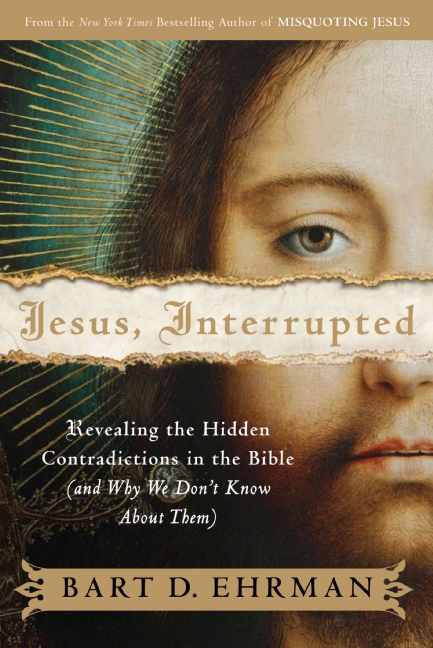 So far it is a fascinating account of discrepancies in the Bible. Most of the inconsistencies are minor and not really noteworthy. However there are several inconstancies that are seemingly, if not completely, irreconcilable. These include the stories of Jesus’ birth, miracles, life, death, trial, and resurrection. And all of these discrepancies are learned by all who attend seminary; this is common knowledge to all pastors, priests, reverends, clergy, and so on. The question is why don’t pastors pass on this historical/critical information onto their parishioners? Are they afraid that such information will lead to the faithful losing their faith? I don’t know, but if that is the case I think that pastors are underestimating the faith of their congregations. While there are many discrepancies, Dr. Ehrman maintains, even though he is a self-professed agnostic, that one can know about such contradictions and still maintain faith in god. However one cannot believe that the Bible is inerrant, it’s not.
 Often I have wondered, as have many others, why I haven’t caught many of these very obvious contradictions. Dr. Ehrman has an answer to this, vertical reading. Most people read anthologies from the top of the page to the bottom and from the first chapter to the last. So when you read the crucifixion story of Jesus in Matthew you don’t realize the differences in the story by the time you get to read it John. You end up naturally weaving the stories together; you fill in the blanks. The solution to this is what Dr. Ehrman calls horizontal reading. So instead of reading through Matthew then Mark and so on; read the resurrection story in Matthew then read the account in John keeping track of the details of both. Basically you want to read the accounts side-by-side. It is when you read horizontally that you notice the inconsistencies in the different gospel accounts.
Since it is Christmas time I thought I would talk a bit about the nativity and what the Bible says about it, or rather what Dr. Ehrman says about it. We all know the story of Jesus‘ birth and according to Dr. Ehrman we get our account of the birth of Christ from two gospels: Matthew and Luke, and these two accounts are irreconcilable; at the very least difficult to reconcile. Dr. Ehrman explains below:
“The differences between the accounts are quite striking. Virtually everything said in Matthew is missing from Luke, and all the stories of Luke are missing from Matthew. Matthew mentions dreams that came to Joseph that are absent in Luke; Luke mentions angelic visitations to Elizabeth and Mary that are absent in Matthew. Matthew has the wise men, the slaughter of the children by Herod, the flight to Egypt, the Holy Family bypassing Judea to return to Nazareth, all missing from Luke. Luke has the birth of John the Baptist, the census of Caesar, the trip to Bethlehem, the manger and the inn, the shepherds, the circumcision, the presentation in the Temple, and the return home immediately afterward, all of them missing from Matthew.” (Jesus Interrupted pg. 33)
Do these contradictions mean that the event didn’t happen? No, not necessarily. It just means, at the very least, that someone was wrong in their account of the event. I think what is important here, as does Dr. Ehrman, is that when one reads the Bible that one should read each gospel for itself. In other words, read John for John; not Luke for John. Each author had a particular theological theme that they were trying to convey. If you read Matthew to fill in or understand Mark then you are missing the point of Matthew. This idea of reading a single gospel for itself is something that Dr. Ehrman discusses in more detail in his book, and something that I hope to expand on here at a later date.
Tuesday, January 27, 2009
Interested in how the New Testament came to be?
Bart D. Ehrman is a NT (New Testament) scholar and professor at the University of North Carolina Chapel Hill. He is also an author of several books such as "God's Problem", "Lost Scriptures", "Gospel of Judas", and his most famous book "Misquoting Jesus". In the following video, Dr. Ehrman gives a lecture on his book, "Misquoting Jesus", which talks about how the NT came to be and what has been changed. It is a long lecture (1:40:00) but worth it if you are interested in textual criticism.
Enjoy!
D
Enjoy!
D
Subscribe to:
Posts (Atom)